Consolidated Message Guide for Ebola Communication in Sierra Leone
- BBC Media Action
- U.S. Centers for Disease Control and Prevention (CDC)
- Focus 1000
- Goal
- Restless Development
Consolidated Message Guide for Ebola Communication in Sierra Leone
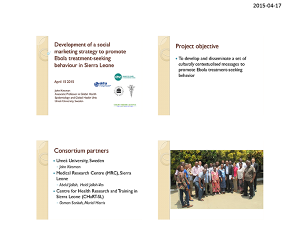
Ebola messages based on their qualitative research done in hotspot areas of Bombali and Urban Freetown, Jan-Feb 2015.
[one_half]A set of empirically-derived Ebola messages for Sierra Leone [Download]

Social Mobilization in the Freetown Peninsula during the Ebola Epidemic 2014-2015
Ebola Response System Strengthening along Western Area Peninsula Coastline – LESSONS LEARNED
The Knowledge, Attitudes and Practice (KAP) study was conducted between December 7th and 22nd, 2014, to gauge the success of social mobilization efforts to educate the general public on key Ebola prevention messages in the country. The study design included quantitative and qualitative components. A questionnaire survey from a representative sample of 1,140 households was conducted in 6 purposely selected counties (Montserrado, Grand Gedeh, Lofa, Nimba, River Cess and Grand Cape Mount). Counties were selected to cover a range in the timing and impact of the Ebola epidemic in different parts of Liberia. The qualitative component was included to provide social context, collective understanding, and evolving debates behind static survey responses. It consisted of a series of 28 focus group discussions among 224 men and women conducted around the same time period in the same six counties. Groups were divided by gender and urban-rural residence, with additional groups for those in professional occupations. The topic guide generally followed a similar structure to the survey questionnaire in order to facilitate comparison across both data sources.
National Knowledge, Attitudes and Practices (KAP) Study on Ebola Virus Disease in Liberia

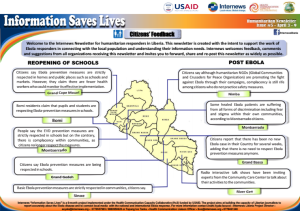
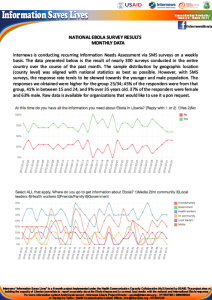
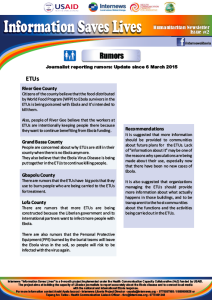
This newsletter is created with the intent to support the work of Ebola responders in connecting with the local population and understanding their information needs.
The Internews Newsletter for Media in Liberia is created with the intent to support the work of local media in reporting about Ebola and Ebola related issues in Liberia. The newsletter aggregates important information and resources for media so that the information they provided is accurate, consistent and reliable.
The Ebola Communication Network was originally developed by the Health Communication Capacity Collaborative (Cooperative Agreement #AID-OAA-A-12-00058) and expanded under Breakthrough ACTION (Cooperative Agreement #AID-OAA-A-17-00017) both under the leadership of Johns Hopkins Center for Communication Programs. This website is now maintained by Johns Hopkins Center for Communication Programs and its contents are the sole responsibility of CCP. The contents of this website do not necessarily reflect the views of USAID, the United States Government, or Johns Hopkins University.