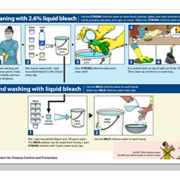
CDC – Cleaning with 2.6 Liquid Bleach
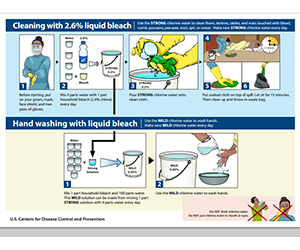 Poster explaining how to clean using 2.6 liquid bleach solution.


Poster explaining how to clean using 2.6 liquid bleach solution.
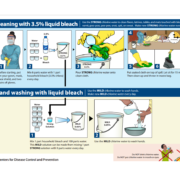
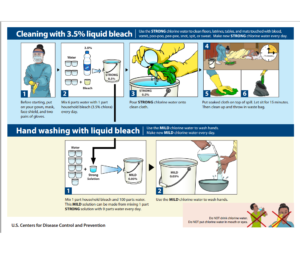 Poster explaining how to clean with a 3.5% liquid bleach solution.
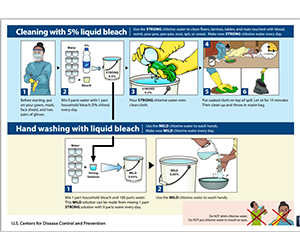 Poster displaying how to clean and wash hands with 5% bleach solution.
 Provision of water and sanitation plays an essential role in protecting human health during all disease outbreaks, including the current Ebola Virus Disease (EVD) outbreak. Good and consistently applied water, sanitation and hygiene (WASH) practices, both in health-care settings and the community will further help to prevent human-to-human transmission of EVD and many other infectious diseases.
Ebola Virus Disease (EVD) Key questions and answers concerning water, sanitation and hygiene
 These messages were developed based on the US CDC’s Ebola Guidelines for Health Workers[1]. The course is available for general use and modification under a creative commons license. IntraHealth recommends that the course be adapted to meet national guidelines and language.
The course presented here is a series of SMS message (140 characters or less) to be sent over a period of a week or two to health workers. SMSs can be sent out to health workers’ mobile phone numbers via systems such as RapidSMS[2] using an iHRIS[3] HR database or another compatible system.
Ebola SMS Messages for Health Workers
[line][1] http://www.cdc.gov/vhf/ebola/hcp
[3] http://www.ihris.org/ iHRIS is currently being used by 19 countries to manage over 1 million health worker HR records.
 IntraHealth International has developed an Ebola Interactive Voice Response (IVR) course. These messages were developed based on the US CDC’s Ebola Guidelines for Health Workers[1]. The course is available for general use and modification under a creative commons license. We recommend that the course be adapted to meet national guidelines and language.
The IVR course is especially useful for illiterate or semi-literate community health workers and for health workers who speak minority languages for which it can be difficult to find sufficient numbers of qualified face-to-face trainers.
The course presented here is a series of essential Ebola questions and answers.
Ebola mLearning Course for Health Workers
[line]
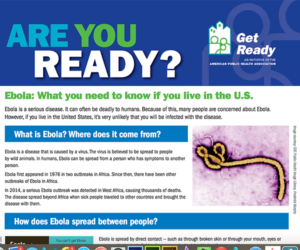 APHA’s Get Ready campaign helps Americans prepare themselves, their families and their communities for all disasters and hazards, including pandemic flu, infectious disease, natural disasters and other emergencies. This fact sheet address Ebola.
 USAID asked NetHope to provide an overview of the state of the information and communications technology (ICT) capabilities in Liberia in three key areas: (a) network and Infrastructure, (b) software and platforms, and (c) digital payments to be used as enabling tools to assist in containing Ebola.
This report was created as part of a two-week rapid assessment. It includes information from first-hand reports from multiple response organizations, discussions with USAID Mission staff in Liberia and implementing partners, and desk research. It is meant to provide a snapshot of the current on-the-ground situation in Liberia and is a first step toward a longer, more exhaustive assessment necessary to gather empirical data.
Information and Communications Technology Response to the Liberia Ebola Crisis
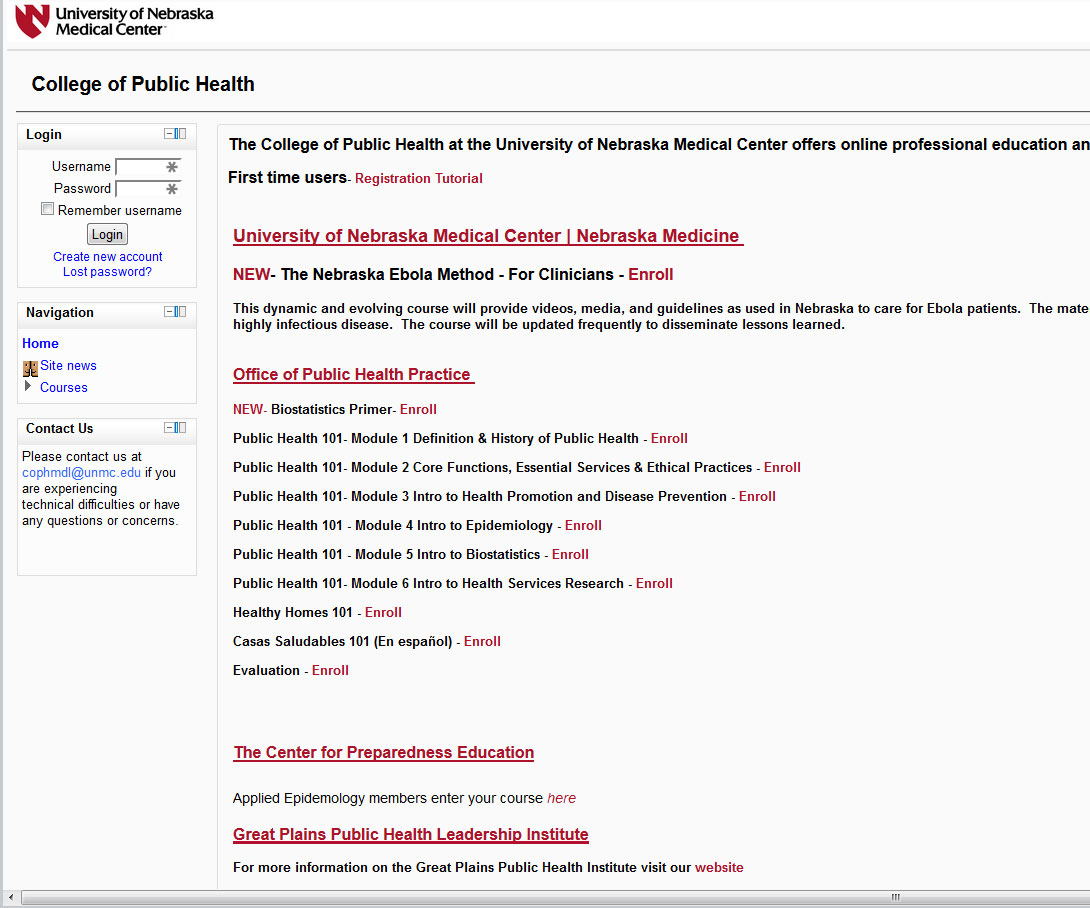 This course from the University of Nebraska provides videos, media, and guidelines as used in Nebraska to care for Ebola patients. The materials share current processes being used to safely care for patients with this dangerous, highly infectious disease.
The course will be updated frequently to disseminate lessons learned.

The Ebola Communication Network was originally developed by the Health Communication Capacity Collaborative (Cooperative Agreement #AID-OAA-A-12-00058) and expanded under Breakthrough ACTION (Cooperative Agreement #AID-OAA-A-17-00017) both under the leadership of Johns Hopkins Center for Communication Programs. This website is now maintained by Johns Hopkins Center for Communication Programs and its contents are the sole responsibility of CCP. The contents of this website do not necessarily reflect the views of USAID, the United States Government, or Johns Hopkins University.