

This guide will be useful for designing more effective outbreak response measures. It can be scaled up or down, depending on the situation. It can be applied at sub-national and national levels and was designed for developmental communication and health promotion personnel working in multidisciplinary teams to investigate and respond to disease outbreaks.
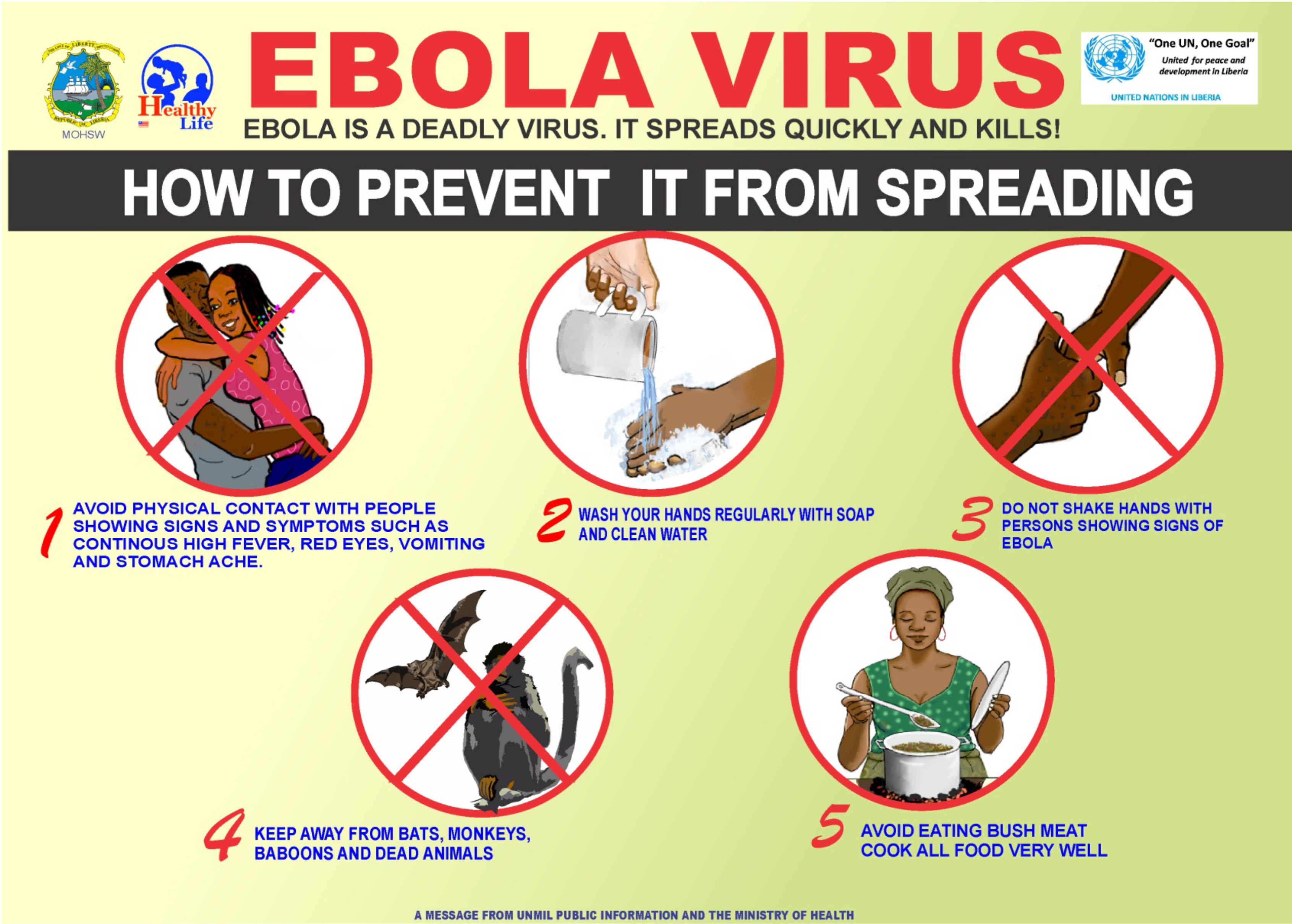
This poster lists and illustrates five ways to keep Ebola from spreading:
 The poster has information about how the virus is transmitted from animals to humans. The audience is Liberian communities where introduction of the virus from bushmeat is a primary danger. The poster is clear, bright, and understandable.
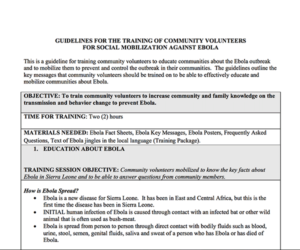 This is a guideline for training community volunteers to educate communities about the Ebola outbreak and to mobilize them to prevent and control the outbreak in their communities. The guidelines outline the key messages that community volunteers should be trained on to be able to effectively educate and mobilize communities about Ebola.
The objective of these guidelines is to train community volunteers to increase community and family knowledge on the transmission and behavior change to prevent Ebola. Included is basic information about Ebola, communication skills training for community volunteers, and explanations of the five stages of behavior change and the five stages of grief.
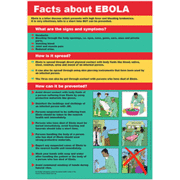
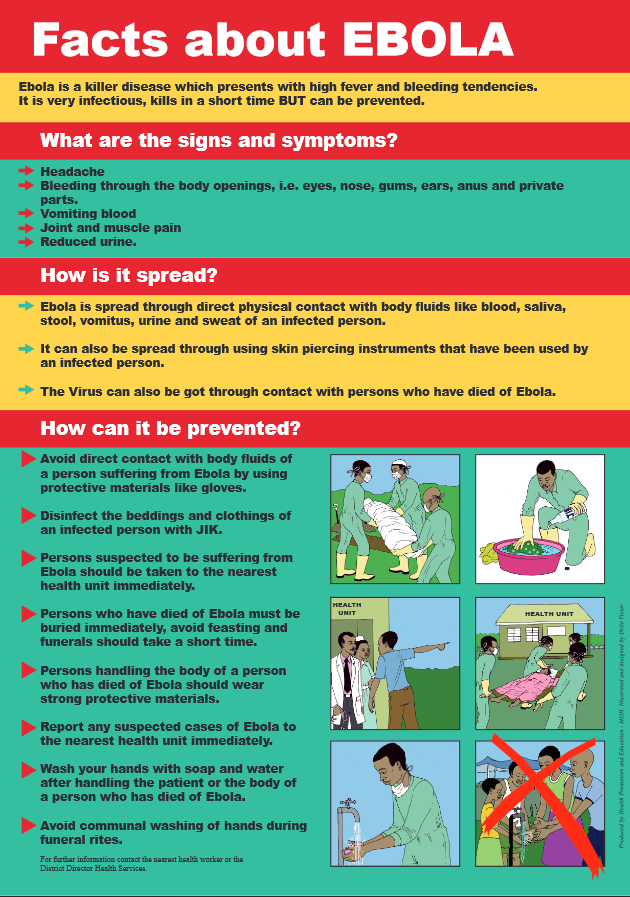 Produced by UNICEF for Uganda, this poster provides information on recognizing signs and symptoms, transmission as well as information on prevention.
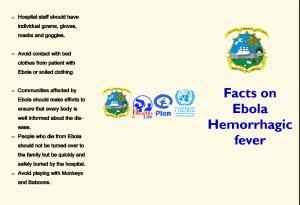 http://www.unicef.org/cbsc/files/Ebola_Brochure-Liberia-EN.pdf
This pamphlet explains what Ebola is, how it is spread, its signs and symptoms, and how it can be prevented. It directs information to community members as well as to health workers.
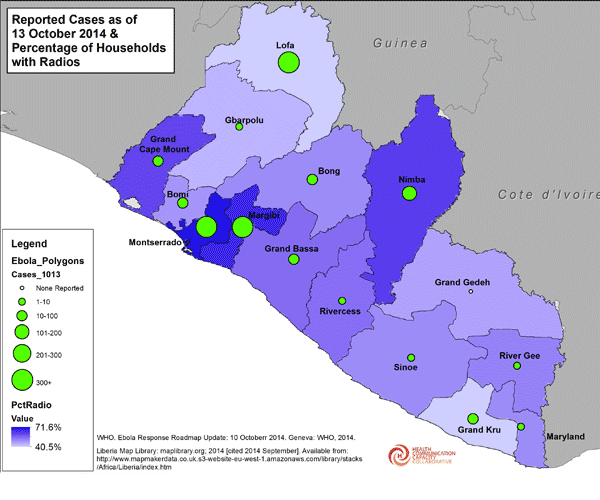 Reported Ebola Cases & Percentage of Households with Radios, as of October 13, 2014 (Full Size JPG)

The Ebola Communication Network was originally developed by the Health Communication Capacity Collaborative (Cooperative Agreement #AID-OAA-A-12-00058) and expanded under Breakthrough ACTION (Cooperative Agreement #AID-OAA-A-17-00017) both under the leadership of Johns Hopkins Center for Communication Programs. This website is now maintained by Johns Hopkins Center for Communication Programs and its contents are the sole responsibility of CCP. The contents of this website do not necessarily reflect the views of USAID, the United States Government, or Johns Hopkins University.