The Lancet Ebola Resource Centre
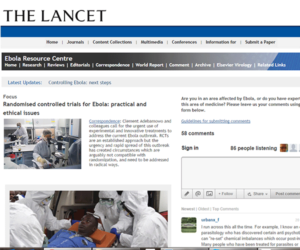 An online collection of Lancet articles and other resources for health professionals.


An online collection of Lancet articles and other resources for health professionals.

 This open copyright course consists of 12 questions and answers for health workers to provide them with basic information on Ebola prevention, diagnosis, care, and communication. The course is designed to be delivered as an Interactive Voice Response course on standard mobile phones. It is meant to be adapted to local language and Ebola guidelines.
This open copyright course consists of 23 SMS texts for health workers to provide them with basic information on Ebola prevention, diagnosis, care, and communication. It is meant to be adapted to local language and Ebola guidelines.
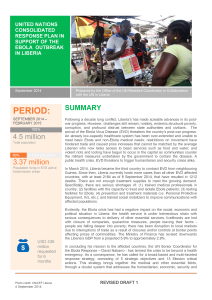 In light of escalating Ebola Virus Disease crisis in Liberia, this Consolidated Plan builds on the original Joint UN Support Plan launched by the UN system in Liberia on the 14th of August in Liberia.
United Nations Consolidated Response Plan in Support of the Ebola Outbreak in Liberia
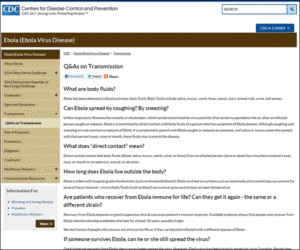 From the CDC, questions and answers about the transmission of Ebola.
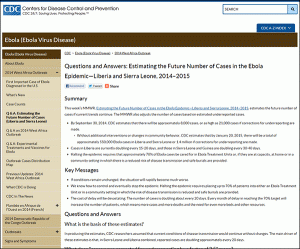 Questions and answers about estimating the future number of Ebola cases in Liberia and Sierra Leone.
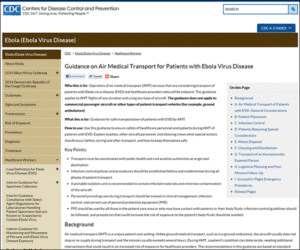 From the CDC, guidance for air medical transport operators who are considering transporting patients with Ebola and the healthcare workers who will also be onboard.
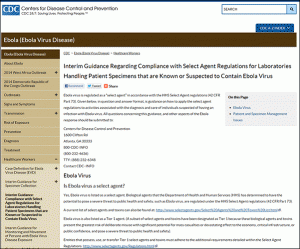 Interim guidance regarding compliance with select agent regulations for laboratories handling patient specimens that are known or suspected to contain Ebola virus.
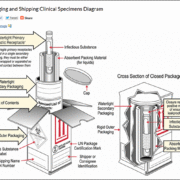
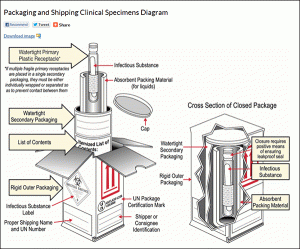 Diagram from the CDC on how to package and ship a clinical specimen.
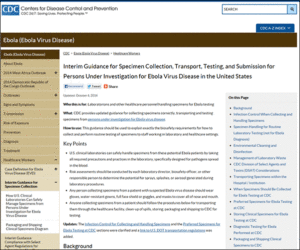 Interim information regarding collection, transport, testing and submission of specimen for patients with suspected infection of Ebola.

The Ebola Communication Network was originally developed by the Health Communication Capacity Collaborative (Cooperative Agreement #AID-OAA-A-12-00058) and expanded under Breakthrough ACTION (Cooperative Agreement #AID-OAA-A-17-00017) both under the leadership of Johns Hopkins Center for Communication Programs. This website is now maintained by Johns Hopkins Center for Communication Programs and its contents are the sole responsibility of CCP. The contents of this website do not necessarily reflect the views of USAID, the United States Government, or Johns Hopkins University.