CDC – Tools for Protecting Healthcare Personnel
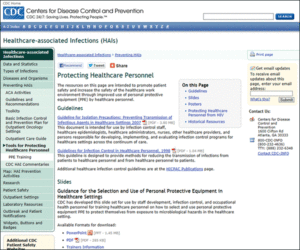 Guidelines for protecting healthcare personnel from the CDC.

 Guidelines for protecting healthcare personnel from the CDC.
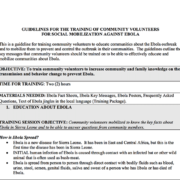
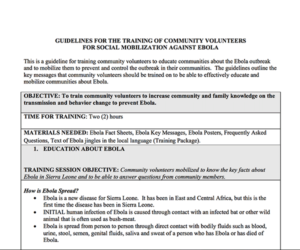 This is a guideline for training community volunteers to educate communities about the Ebola outbreak and to mobilize them to prevent and control the outbreak in their communities. The guidelines outline the key messages that community volunteers should be trained on to be able to effectively educate and mobilize communities about Ebola.
The objective of these guidelines is to train community volunteers to increase community and family knowledge on the transmission and behavior change to prevent Ebola. Included is basic information about Ebola, communication skills training for community volunteers, and explanations of the five stages of behavior change and the five stages of grief.
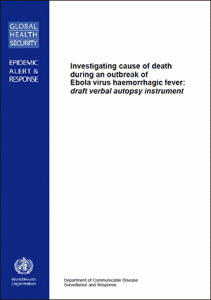 World Health Organization report presenting a draft verbal autopsy instrument based on best judgement and previous experience in a variety of settings including outbreaks and research. It is part of a wider effort by the Global Outbreak Alert and Response Network (GOARN) to develop tools for testing in advance of outbreak situations. The report also contains information on how to carry out a validation study, which compares the results of a verbal autopsy questionnaire with the results of a “gold standard” – such as laboratory test or clinical diagnosis. To date, there is no standard, verbal autopsy instrument for use during outbreaks of Ebola virus haemorrhagic fever (EHF).
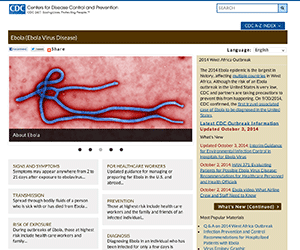 The Centers for Disease Control and Prevention’s (CDC) website for Ebola information.
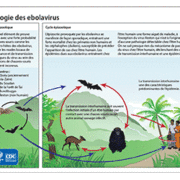
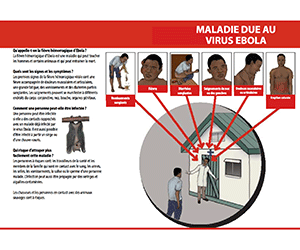
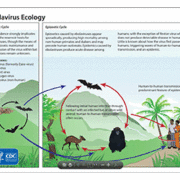
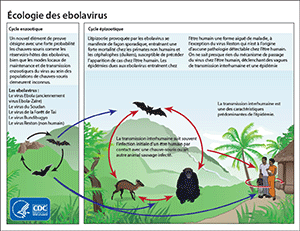 CDC graphic in French shows the life cycle of the ebola virus. Bats are strongly implicated as both reservoirs and hosts for the ebolavirus. Of the five identified ebolavirus subtypes, four are capable of human-to-human transmission. Initial infections in humans result from contact with an infected bat or other wild animal. Strict isolation of infected patients is essential to reduce onward ebolavirus transmission. (CDC Website)
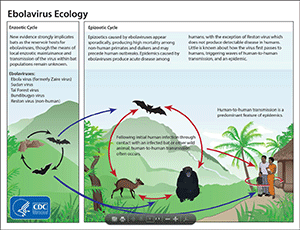 CDC graphic shows the life cycle of the ebolavirus. Bats are strongly implicated as both reservoirs and hosts for the ebolavirus. Of the five identified ebolavirus subtypes, four are capable of human-to-human transmission. Initial infections in humans result from contact with an infected bat or other wild animal. Strict isolation of infected patients is essential to reduce onward ebolavirus transmission. (CDC Website)
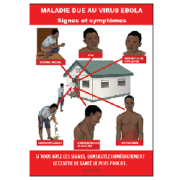
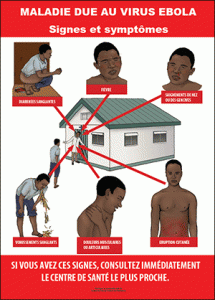 Signs and symptoms (French)
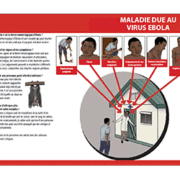
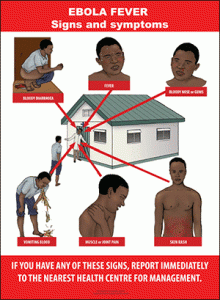 This poster shows the signs and symptoms of Ebola fever through illustrations. Anyone with the symptoms is encouraged to go to a health centre.
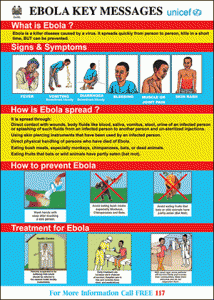 Signs and symptoms, transmission, prevention and treatment information for Ebola.

The Ebola Communication Network was originally developed by the Health Communication Capacity Collaborative (Cooperative Agreement #AID-OAA-A-12-00058) and expanded under Breakthrough ACTION (Cooperative Agreement #AID-OAA-A-17-00017) both under the leadership of Johns Hopkins Center for Communication Programs. This website is now maintained by Johns Hopkins Center for Communication Programs and its contents are the sole responsibility of CCP. The contents of this website do not necessarily reflect the views of USAID, the United States Government, or Johns Hopkins University.