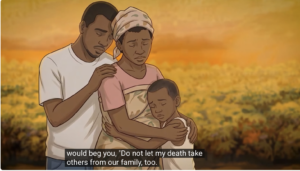
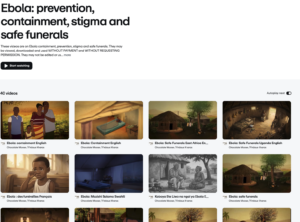
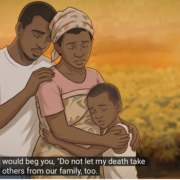
Do Not Let My Death From Ebola You Too is a deeply moving animated video created by Chocolate Moose Media (https://chocmoose.com/), written and directed by Firdaus Kharas, OC, for Harper Hill Global (https://www.harperhill.global/). The video speaks directly to families and communities facing one of the most painful realities of Ebola: the death of someone they love. It is currently available in East Africa English, Uganda English, French, Congolese Swahili, Lingala, Luganda, and Lugbara in low and high resolution.
With tenderness, dignity and emotional clarity, the video acknowledges the natural human desire to bring a loved one home, to hold them, to wash the body, to kiss them goodbye and to honor them according to familiar traditions. But it then delivers a lifesaving message: with Ebola, love must be expressed differently. The last act of love is not touch. It is protection.
The video explains, in a compassionate and culturally sensitive way, that Ebola can hide inside grief. It can spread through the very acts that normally express devotion: an embrace, a washing, a final kiss. Rather than blaming families or attacking tradition, the video reframes safe burial as an act of love, faith and honour. It reassures viewers that the soul of the person who has died is not dishonoured when trained hands carry the body safely. God sees the love, the tears, the prayers and the goodbye spoken from a distance.
This is public health communication at its most humane. It does not lecture. It comforts. It does not frighten people into obedience. It helps them understand that protecting the living is the final gift they can give to the dead.
The message is simple, urgent and unforgettable: Honor the dead. Protect the living. Let love save lives.
The video is free to view, download and use, making it a powerful resource for churches, clinics, schools, community health workers, broadcasters, humanitarian organizations, local leaders and families in Ebola-affected communities.



 This radio spot addresses the topic: “Why avoid direct contact during an Ebola outbreak?”, and is produced in 5 languages (French, Swahili, Kikongo, Lingala and Tshiluba).
 This radio spot addresses the topic: “Can a woman cured of Ebola still breastfeed her children?”, and is produced in 6 languages (French, Swahili, Kikongo, Lingala, Tshiluba and Kinande).
 This radio spot addresses the topic: “How are carriers involved in Ebola prevention?”, and is produced in 6 languages (French, Swahili, Kikongo, Lingala, Tshiluba and Kinande).
 This radio spot addresses the topic: “Can an Ebola patient be cured?”, and is produced in 6 languages (French, Swahili, Kikongo, Lingala, Tshiluba and Kinande).


 This radio spot addresses the topic: “What are the effects of Ebola virus on babies of pregnant women during and after recovery?”, and is produced in 6 languages (French, Swahili, Kikongo, Lingala, Tshiluba and Kinande).